Description
Legend Channel: A Complete Analog Channel Strip Plugin
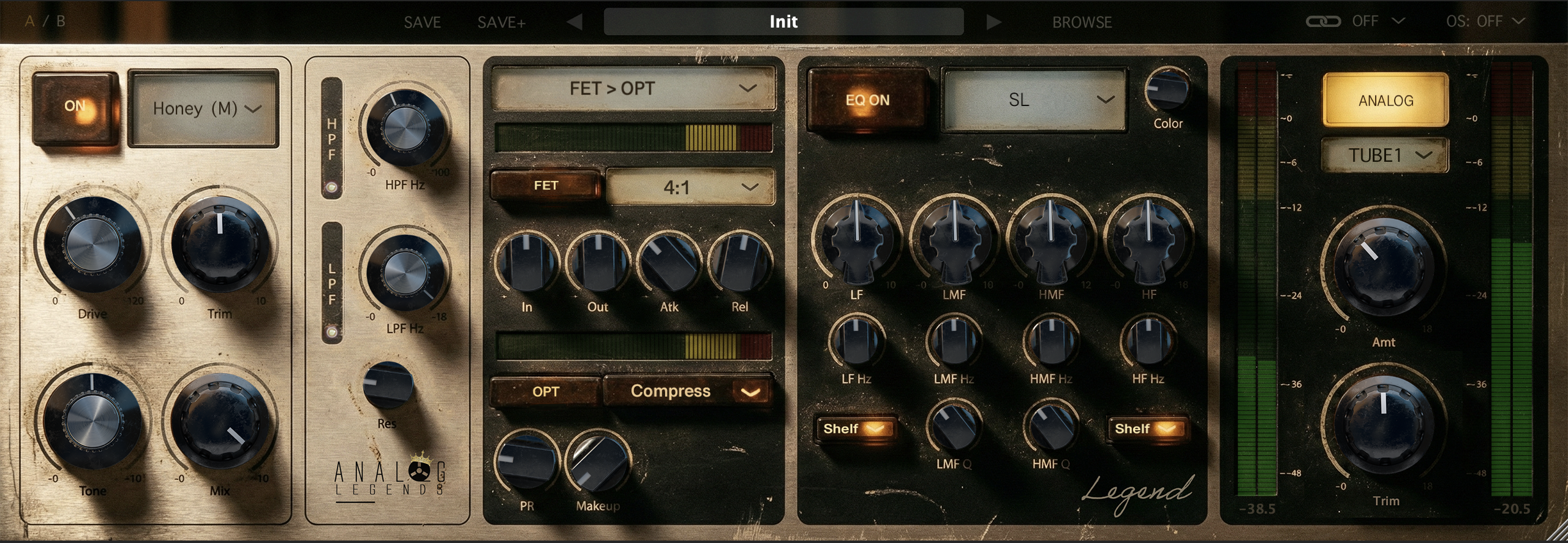
Legendary Preamps. Two Iconic Compressors. Two Classic Console EQs. One Complete Channel.
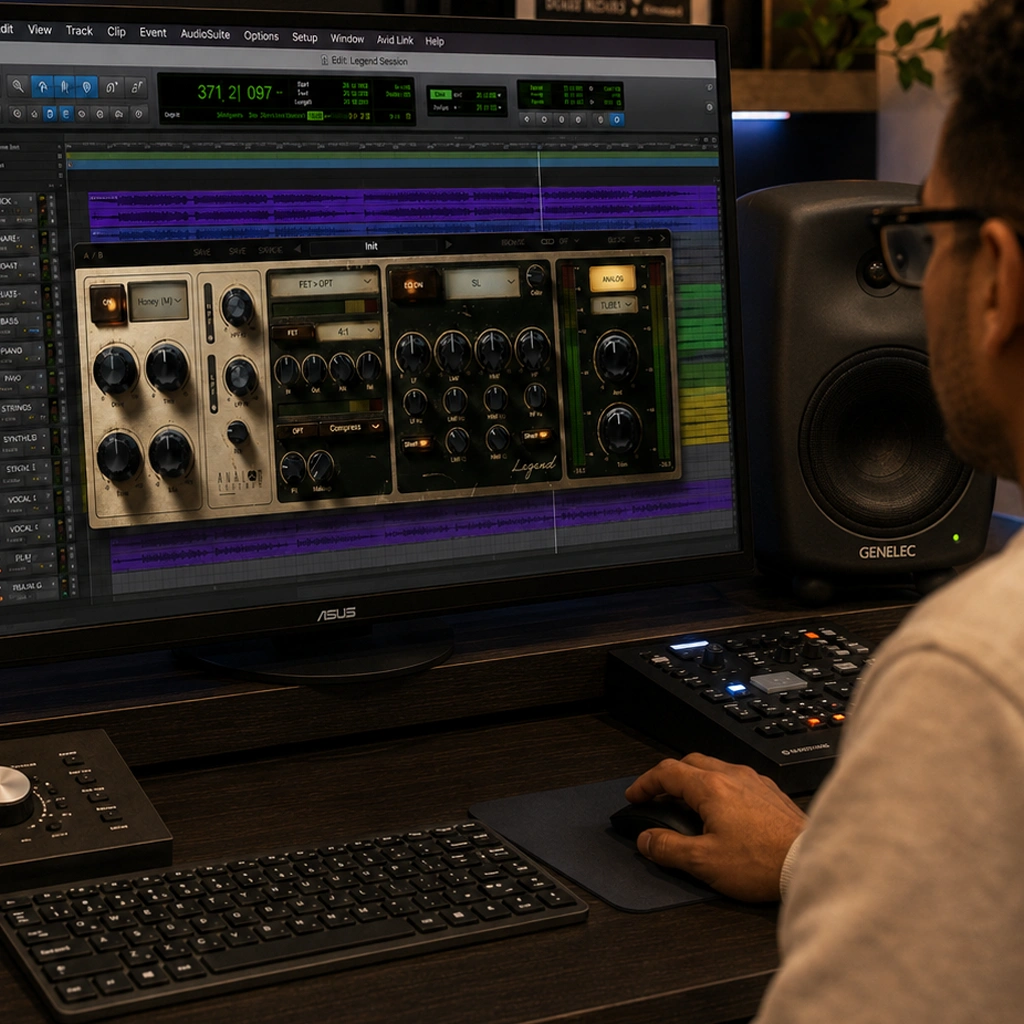
Legend Channel is a channel strip plugin that brings the sound, response, and workflow of a complete analog recording chain into your DAW.
Inside one cohesive channel strip plugin, you get:
- Nine modeled analog preamp paths
- Fast, aggressive 1176-style FET compression
- Smooth, program-dependent LA-2A-style optical leveling
- Precise and punchy SSL-style console EQ
- Broad and musical Neve-style Class-A EQ
- Modeled tube, transformer, and solid-state output stages
- High-pass and low-pass filters with resonance
- Up to 16× oversampling
- Four-slot Channel Linking
- 719 professionally designed factory presets
This is not a collection of unrelated analog-style effects placed inside one interface.
Legend Channel was designed as a complete, interactive signal path in which the preamp, filters, compression, EQ, gain staging, harmonic coloration, and output stage work together.
It is the recording chain many producers spend years trying to assemble—inside one plugin.
Built From a Dream I Could Not Afford
When I was starting out as a producer, I wanted the same equipment I saw in professional studios: an Avalon VT-737SP, a Neve or API preamp, an 1176, an LA-2A, and a real large-format console.
I could not afford any of it.
Some of my earliest jobs were taken for one reason: to save enough money to purchase my first serious piece of recording equipment.
When I finally bought an Avalon, I immediately understood why that hardware mattered. Recordings gained weight, depth, presence, and polish before I had even begun mixing. It was not simply louder, warmer, or more saturated. The signal responded differently.
That purchase made a meaningful difference in my sound and, ultimately, in my career.
Legend Channel is the plugin I wish had existed before I could afford that equipment.
I did not want to create another channel strip plugin that merely looked familiar or combined generic saturation with an EQ and compressor. I wanted to capture what made the original hardware special: the way its frequency balance, harmonics, dynamics, and timing continuously changed with the incoming signal.
To my ears, Legend Channel is the closest I have heard software come to the experience of recording and mixing through that kind of analog chain.
Real Hardware Does More Than Add Saturation
Many analog-style plugins rely on a simplified formula:
Fixed EQ curve + static saturation = analog tone
Real analog hardware does not behave statically.
- Transformers saturate differently across the frequency spectrum
- Tubes generate evolving harmonic structures
- Low frequencies affect the circuit differently than high frequencies
- Transients change the apparent tone and density
- Compression timing shifts according to the source material
- Multiple stages interact with one another
- The sound continues to move even when the controls remain unchanged
A real preamp does not add the same coloration to every signal at every level. An 1176 does not respond identically to a kick, vocal, bass, and snare. An optical compressor does not release according to one fixed mathematical curve.
This constantly changing behavior is what gives analog recordings their depth, movement, and three-dimensional character.
Legend Channel was built to reproduce that behavior—not merely imitate its surface characteristics.
Powered by Dynamic Tonality Engine™
Analog That Reacts. Not Imitates.
At the heart of Legend Channel is our proprietary Dynamic Tonality Engine™, or DTE.
DTE was developed by measuring the frequency response and harmonic behavior of analog hardware across the audible spectrum and at multiple operating levels.
Instead of capturing one static tonal snapshot, DTE uses six separate multiband Color Anchors for each modeled stage. Every anchor represents a different measured operating state of the hardware.
As the incoming signal changes, DTE continuously interpolates between those states.
The result is tone that moves with the music.
Push the preamp harder and the harmonic structure evolves. Drive the compressor and its coloration changes along with its gain reduction. Increase the output level and the final stage progressively adds density, weight, and cohesion.
The sound is never simply pasted on top of the signal.
It responds to it.
Compression Modeled Beyond the Gain-Reduction Curve
The FET and optical compressor sections were not designed using attack and release labels alone.
The dynamic behavior of the original hardware was measured across the frequency spectrum, including the way attack and release characteristics shift according to the frequency content, energy, and dynamics of the incoming signal.
This matters because real analog compressors do not respond to every transient, frequency, and source in exactly the same way.
This channel strip plugin captures the contrast between two fundamentally different compression designs.
FET Compressor
Fast, aggressive, energetic, and capable of adding unmistakable harmonic attitude.
Inspired by the response of the classic blackface 1176 design, the FET compressor is ideal for:
- Vocals that need urgency and presence
- Drums that need punch and impact
- Bass that needs control without losing aggression
- Parallel compression
- Sources that need to move forward in the mix
Available ratios: 4:1, 8:1, 12:1, and 20:1.
Use it lightly for fast, controlled dynamics or drive it harder for the explosive character that made the original circuit legendary.
Optical Leveling Amplifier
Smooth, musical, and naturally program-dependent.
Inspired by the response of the classic LA-2A design, the optical compressor reacts more gradually and breathes with the source. Its release behavior adapts to the material instead of following one simple, fixed envelope.
It is especially effective for:
- Lead and background vocals
- Bass guitar
- Acoustic instruments
- Guitars
- Keys
- Buses and sustained material
The FET model grabs.
The optical model glides.
Together, they provide two of the most important compression sounds in recorded music.
Nine Analog Preamp Paths
Choose the Front End of Your Recording Chain
The Preamp section is where the sound of Legend Channel begins.
Nine distinct signal paths provide a wide range of analog behavior, from clean and controlled to thick, driven, and harmonically complex.
Each analog preamp family includes both Line and Mic versions.
Line mode offers a more restrained response suited to mixing and subtle coloration. Mic mode drives deeper into the modeled circuit behavior for stronger harmonic movement, saturation, and tonal transformation.
Honey Line and Honey Mic
Inspired by classic American console preamps.
- Tight low frequencies
- Punchy, articulate mids
- Forward presence
- Controlled transformer character
- A confident, record-ready sound
Excellent for drums, vocals, bass, guitars, and sources that need to cut through a dense arrangement.
Velvet Line and Velvet Mic
Inspired by classic tube recording and broadcast circuits.
- Thick low-mid body
- Smooth transient rounding
- Rich tube harmonics
- Softer upper frequencies
- A polished sense of depth
Ideal for vocals, keys, bass, acoustic instruments, and thin digital recordings that need greater dimension.
Steel Line and Steel Mic
Inspired by fast solid-state console designs.
- Fast transient response
- Controlled aggression
- Clear upper-mid definition
- Tight low-end behavior
- A focused, modern edge
A strong choice for drums, percussion, synths, guitars, and sources that need clarity without sounding sterile.
Iron Line and Iron Mic
Inspired by British Class-A transformer preamps.
- Heavy low-frequency weight
- Dense transformer harmonics
- Rich midrange character
- Smooth saturation
- The unmistakable size associated with classic British recording chains
Ideal for vocals, drums, bass, samples, instruments, and any source that needs to sound larger and more authoritative.
Clean
A transparent signal path for precise control when analog coloration is not required.
Use Clean when you want the filtering, EQ, dynamics, and workflow of Legend Channel while preserving the original character of the recording.
Preamp Controls
Drive
Drive controls how deeply the signal enters the modeled preamp behavior.
Because Drive is connected to Dynamic Tonality Engine™, increasing it does more than add distortion. It changes the frequency response, harmonic balance, density, transient behavior, and perceived depth of the source.
Trim
Trim provides accurate output compensation, allowing you to evaluate tonal changes without being misled by increased loudness.
Tone
Tone is a fast, musical tilt control for brightening or darkening the source before it moves through the rest of the channel.
It is designed for broad tonal decisions rather than corrective equalization.
Two Legendary Console EQs
This channel strip plugin includes two completely different EQ architectures.
These are not cosmetic variations of the same digital equalizer. Each model follows a different control philosophy and produces a distinctly different musical result.
Modern British EQ
Precision, Punch, and Console Authority
Inspired by the classic SSL Black Series 4000-style equalizer, the Modern British EQ combines detailed control with the focused punch associated with large-format mixing consoles.
- Four integrated EQ bands
- Switchable shelf or bell operation on the low and high bands
- Fully variable Q controls on the midrange bands
- Precise frequency selection
- Focused and assertive tonal shaping
This is the EQ for precision, clarity, and impact.
Vintage British EQ
Broad, Musical, and Effortlessly Expensive
Inspired by legendary Neve 10-Series Class-A, inductor-based equalizers, the Vintage British EQ is designed for bold tonal shaping rather than microscopic correction.
- Fixed 12 kHz high shelf
- Inductor-style midrange band
- Stepped frequency selections
- Broad, musical curves
- Classic low-frequency shelf behavior
This is the EQ for color, size, and musical instinct.
Filter Section
Clean Up the Signal or Reshape It Creatively
This channel strip plugin includes integrated high-pass and low-pass filters with smooth 12 dB-per-octave slopes.
The Resonance control adds a tunable peak around the cutoff frequency, allowing the filters to move from transparent cleanup to pronounced analog-style shaping.
Modeled Output Stages
The Final Stage Is Part of the Sound
In a hardware recording chain, the sound does not end after the EQ or compressor.
The final output stage contributes additional harmonics, saturation, density, transient shaping, and cohesion.
Tube 1–3
Three vacuum-tube output stages ranging from controlled triode warmth to richer, more driven pentode-style coloration.
Iron 1–2
Iron 1 is tighter, more controlled, and more modern.
Iron 2 is heavier, softer, and more vintage in its response.
Steel 1–2
Steel 1 remains clean and focused.
Steel 2 introduces greater drive, attitude, and upper-mid energy.
Output Amount
The Output Amount control determines how deeply the signal drives the selected output model.
Use lower settings for subtle analog cohesion or push it harder for more obvious tonal transformation.
A Complete Console-Style Signal Path
Input → Preamp → Filters → Compressor → Equalizer → Output
Every module in Legend Channel was designed to function as part of one connected signal path.
Gain staging matters.
The preamp changes how the compressor responds. Compression alters the level and harmonic structure entering the EQ. The EQ changes the material driving the output stage. The selected output model reacts to everything that came before it.
This interaction is one of the primary reasons hardware chains sound and feel cohesive.
Legend Channel brings that same philosophy into your DAW while retaining the speed, recall, and flexibility of software.
Channel Linking
Control Multiple Tracks Like a Real Console
This channel strip plugin includes an optional four-slot Channel Linking system.
Assign multiple instances to the same link slot, and adjustments made to one instance are immediately reflected across every linked channel.
719 Factory Presets
Real Starting Points for Real Sessions
Legend Channel includes 719 professionally designed factory presets covering vocals, drums, bass, guitars, keys, samples, instruments, buses, mastering applications, sound design, and complete mixing chains.
These are practical starting points built for real recording, production, and mixing sessions.
Advanced Preset Browser
The integrated Preset Browser includes star ratings, searchable tags, custom libraries, custom categories, fast filtering, instant recall, and organized user-preset management.
Built to Live on Every Track
Place Legend Channel first in the chain as a virtual recording front end, use it as your primary mixing channel strip plugin, or drive it as a creative tone-shaping processor.
From gentle analog movement to unmistakable hardware attitude, Legend Channel adapts to the source and the way you work.
Core Features
- Complete analog channel strip in one plugin
- Nine modeled preamp signal paths
- Classic 1176-style FET compression
- Classic LA-2A-style optical leveling
- SSL 4000-style Modern British EQ
- Neve 10-Series-style Vintage British EQ
- Tube, transformer, and solid-state output models
- Proprietary Dynamic Tonality Engine™
- Six multiband Color Anchors per modeled stage
- Four-slot Channel Linking
- 719 professionally designed factory presets
- Up to 16× oversampling
- VST, VST3, AU, AAX, and CLAP formats
Installation and Activation
Supported Plugin Formats
VST, VST3, AU, AAX, and CLAP.
Legend Channel is compatible with macOS and 64-bit Windows, including native support for Intel and Apple Silicon Macs.
Activation
Enter your license key through the on-screen activation overlay the first time you open the plugin. Once activated, the complete processing engine and factory preset library are unlocked.
The Gear That Once Felt Out of Reach
For generations of producers and engineers, professional analog sound was locked behind thousands of dollars in preamps, compressors, equalizers, consoles, converters, and studio wiring.
Legend Channel was created to close that distance.
It brings the character of legendary preamps, the behavior of two iconic compressors, the tone of two classic console EQs, and the finishing weight of modeled output stages into one connected recording chain.
Not as a visual imitation.
Not as a collection of generic analog effects.
As a responsive processor built from measured frequency behavior, harmonic behavior, dynamic timing, and the interaction between every stage.
The analog channel strip plugin I needed when I started is finally here.
One Plugin. A Studio Full of Character.
Track through it. Mix through it. Build your sound around it.
System Requirements
Windows
Windows XP or higher, a minimum screen resolution of 1024 × 768, and at least 1 GB of available storage space.
macOS
macOS 10.13 or higher, a minimum screen resolution of 1024 × 768, and at least 1 GB of available storage space.
Changelog
February 18, 2026 — Version 1.5.0
Public release.
February 19, 2026 — Version 1.5.1
Windows installer update.
March 8, 2026 — Version 1.5.2
Full license-persistence fix.
July 21, 2026 — Version 1.5.3
Windows character models fix.
July 23, 2026 — Version 1.5.4
Stability update on both windows and mac
August 1, 2026 — Version 1.5.5
Build optimizations for mac that drastically decrease resource usage
August 2, 2026 — Version 1.5.6
Fixed license persistence the re-emerged after v1.55 update on certain macs
August 4, 2026 — Version 1.5.7
Fixed rare intermittent high pitched sound originating in FET comp module
August 6, 2026 — Version 1.5.8
Patch for mac systems not including the 709 presets and issues with saving new presets fixed
August 6, 2026 — Version 1.5.9
Patch to fix user preset save and recall in browser on mac
UPDATED VERSIONS AVAILABLE IN YOUR ACCOUNT
Explore more audio effects plugins at FlashVST, or visit developer Analog Legends for more about its audio tools.
Choosing a Channel Strip Plugin for Your Mix
A channel strip plugin brings several processors into one signal path. Legend Channel combines preamp color, filters, compression, EQ and output-stage character, so you can shape a track without building the same chain from separate effects each time.
Can I use this channel strip plugin on vocals and drums?
Yes. Its fast FET compressor can shape transients, while optical leveling offers a smoother response. Start with a suitable preset, adjust the input level and compare with bypass at a similar loudness to judge the change in context.
How is it different from a standalone EQ?
An EQ focuses on frequency balance. This channel strip plugin also provides preamp and output-stage coloration, dynamic control and filtering. You can use those stages together or focus on the processing your track needs.
What should I check before buying?
Check the supported plugin formats and system requirements against your DAW and computer. Watch the demos above to hear the channel strip plugin in use, then compare its workflow with the tools already in your studio.


Reviews
There are no reviews yet.